Introduction
This is the Missile System Design Project documentation. This project explores the design and analysis of missile systems across multiple engineering disciplines.
Warning
Educational Use Only. This project is intended solely for educational and academic purposes. All content is derived exclusively from publicly available, open-source, and non-export-controlled literature. No ITAR-controlled, EAR-controlled, classified, or otherwise restricted information is used or referenced. This documentation does not constitute engineering guidance for the design, development, or manufacture of any weapons system.
Note
This is a work in progress.
Project Overview
This documentation covers:
- Guidance, Navigation, and Control (GNC)
- Systems Engineering
- Aerodynamics
- Structures
- Mechanical Design
Each section provides detailed analysis and design considerations for missile system development.
GNC Overview
The Guidance, Navigation, and Control (GNC) subsystem is responsible for directing the missile to its intended target.
Components
The GNC system consists of three main components:
- Guidance: Determines the desired trajectory to reach the target
- Navigation: Estimates the current position and velocity
- Control: Commands the actuators to follow the desired trajectory
This section provides detailed coverage of each component.
Guidance
The guidance subsystem determines the commanded trajectory required to intercept the target.
Overview
Guidance algorithms calculate the desired acceleration commands based on:
- Current missile state
- Target information
- Engagement geometry
Common guidance laws include:
- Proportional Navigation (PN)
- Augmented Proportional Navigation (APN)
- Pure Pursuit
- Command to Line of Sight (CLOS)
Proportional Navigation
Proportional Navigation (PN) is one of the most widely used guidance laws (Siouris, 2004). The lateral acceleration command is proportional to the line-of-sight (LOS) rate:
where:
- is the commanded lateral acceleration
- is the effective navigation constant (typically 3–5)
- is the closing velocity
- is the line-of-sight rate
The navigation constant in (1) determines the aggressiveness of the guidance law. Higher values result in more aggressive maneuvering but also higher acceleration demands.
Further content will be added here.
Navigation
The navigation subsystem provides state estimation for the missile’s position, velocity, and attitude.
Overview
Navigation systems typically include:
- Inertial Measurement Units (IMU)
- GPS/GNSS receivers
- Sensor fusion algorithms (e.g., Kalman filters)
The navigation system must provide accurate state estimates despite sensor noise and biases.
Sensor Fusion Architecture
graph TD
    IMU["IMU\n(Accelerometers & Gyroscopes)"] --> KF["Kalman Filter\n(State Estimator)"]
    GPS["GPS/GNSS Receiver"] --> KF
    BARO["Barometric Altimeter"] --> KF
    KF --> OUT["Estimated State\n(Position, Velocity, Attitude)"]
    OUT --> CORR["Feedback Correction"]
    CORR --> KF
Further content will be added here.
Control
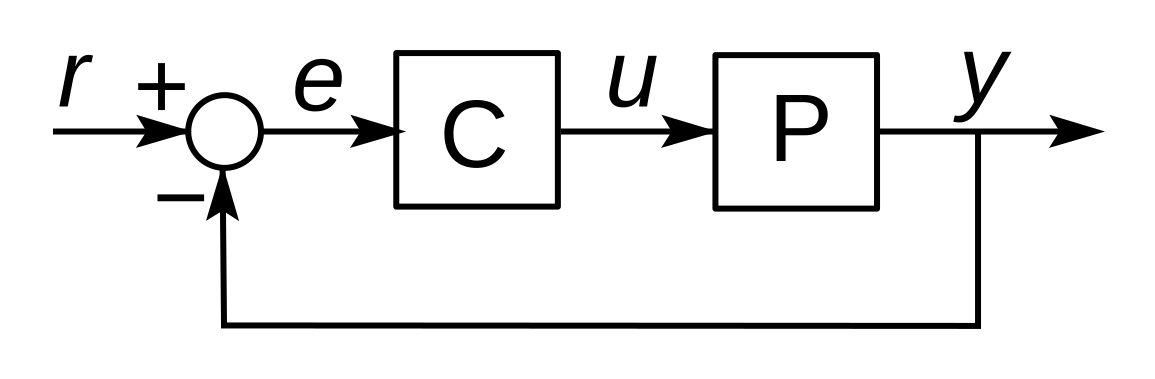
The control subsystem translates guidance commands into actuator commands to control the missile’s motion.
Overview
Control systems must:
- Track commanded accelerations or attitudes
- Maintain stability
- Handle aerodynamic uncertainties
- Respond to disturbances
Common control approaches:
- PID control
- LQR (Linear Quadratic Regulator)
- Model Predictive Control
- Adaptive control
Feedback Control Loop
Further content will be added here.
Systems Engineering
Systems engineering provides the framework for integrating all missile subsystems into a cohesive design.
Overview
Systems engineering activities include:
- Requirements definition and management
- System architecture
- Interface control
- Verification and validation
- Trade studies
Further content will be added here.
Aerodynamics
Aerodynamics analysis determines the forces and moments acting on the missile during flight.
Overview
Key aerodynamic considerations:
- Drag and lift forces
- Stability derivatives
- Control surface effectiveness
- Mach number effects
- Fin and body interactions
Further content will be added here.
Structures
Structural analysis ensures the missile can withstand loads encountered during flight.
Overview
Structural design considerations:
- Material selection
- Load cases (acceleration, aerodynamic, thermal)
- Stress analysis
- Factor of safety
- Weight optimization
Further content will be added here.
Mechanical Design
Mechanical design encompasses the physical configuration and mechanisms within the missile.
Overview
Mechanical design aspects:
- Propulsion system integration
- Actuator mechanisms
- Thermal management
- Packaging and layout
- Manufacturing considerations
Further content will be added here.